First Time Film Photography
The Spark: Why Film, and Why Now
During a conversation with my father, he mentioned that he still had all his old camera gear stored somewhere in the basement. I’d already adapted some of his Zeiss lenses to a modern mirrorless camera and truly enjoyed the process (you can see some examples with the Zeiss Distagon 35mm f/2.8 and the Zeiss Distagon 28mm f/2.8).
What was left now was actually shooting film.
Film photography has seen a quiet resurgence in recent years, and I thought it would be interesting to experience it firsthand. It wouldn’t be entirely accurate to say this was my first time shooting film — I’m sure I took some photos as a kid with disposable cameras — but I don’t have any real memories of those experiences, and many things have changed since then.
What made this moment even more exciting is that I wasn’t starting with a simple 35mm camera. I jumped straight into medium format. And not just any medium format camera — a marvelous Hasselblad.
The Machine — A First Encounter with the Hasselblad
The Hasselblad 500 series has a reputation for being among the finest medium format cameras ever made.
They’re waist-level, modular, fully mechanical, and beautifully crafted machines that need little introduction. Suffice it to say — this is the camera NASA chose to take to the moon.
The particular model I had access to was a 500CM, paired with the legendary Zeiss Planar 80mm f/2.8.
The camera isn’t exactly lightweight, but the ergonomics are still very good. You hold it with your left hand to support the body and trigger the shutter, while your right hand naturally finds its place on the focusing ring of the lens.
But the craziest part is actually looking through the viewfinder, the feeling is nothing short of magical. It feels incredible to experience reality through a glass that instantly adds a touch of nostalgia to every image it reflects.
The First Roll
After getting familiar with the camera and taking a few empty shots, it was time to load my first real roll of film.
The 500CM takes 6×6 images, meaning it uses 120 film. I’d bought two rolls — a Kodak Gold 200 and an Ilford HP5 Plus 400 — and decided to start with the Kodak Gold.
Unwrapping the first roll of film was quite an experience in itself and it gave me the first dopamine rush, and I'm not sure why to be honest.
On a cloudy November day, I headed to Trieste to walk along the Rilke Trail, a scenic path that winds along cliffs overlooking the sea and leads toward the Duino Castle.
Right at the start, the trail offered a breathtaking view of a small marina — and that became my first shot.
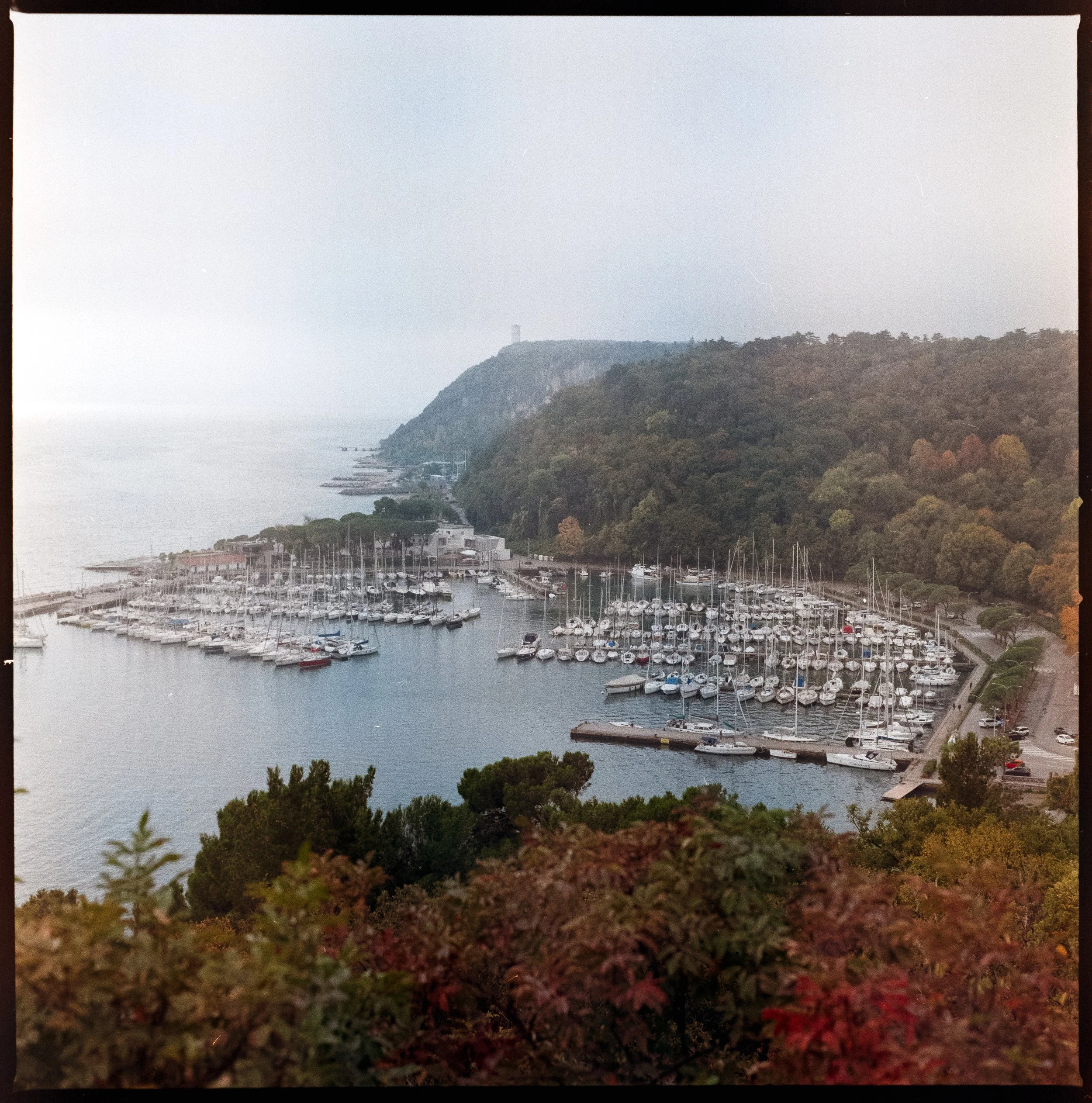
Marina - Hasselblad 500 CM - Kodak Gold 200
One thing worth mentioning: the Hasselblad has no built-in light meter, and I didn’t feel like buying one just for this experiment. Instead, I used my Ricoh GR IIIx (you can find my first impressions of this camera here) to get the exposure settings. For some film purists, that might sound like blasphemy — but it actually worked out surprisingly well. The GR IIIx has a 40mm full-frame equivalent lens, which matches closely with the 80mm on the 6×6 medium format.
The trail offered stunning views of the cliffs along the Adriatic Sea and the distant Duino Castle. Here, I took another shot.
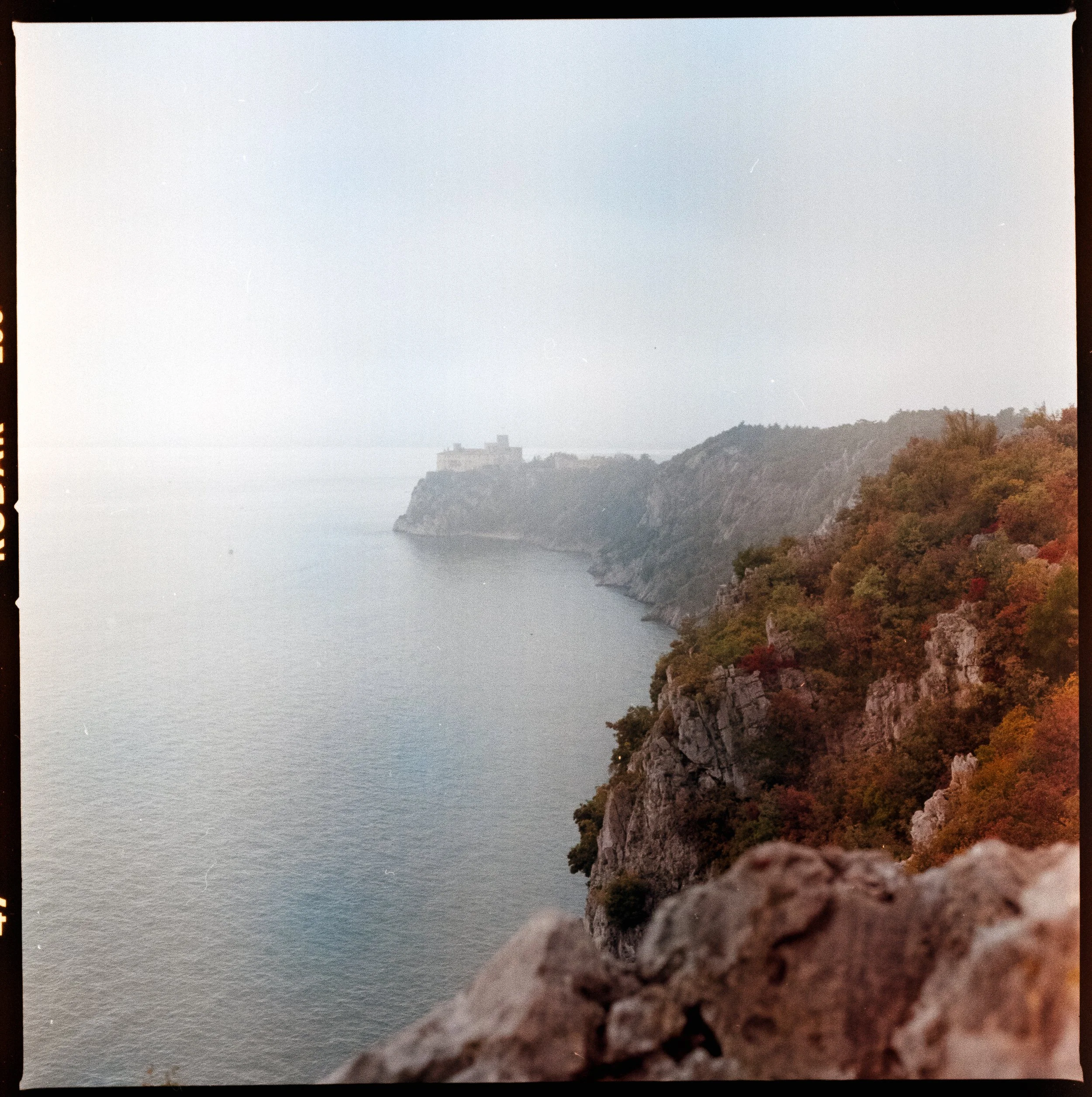
Cliffs - Hasselblad 500 CM - Kodak Gold 200
As we continued along the trail, we got closer and closer to the castle. Getting a clear view, however, became increasingly difficult because of the trees — and I didn’t feel too comfortable walking too close to the cliff’s edge just for a better shot.
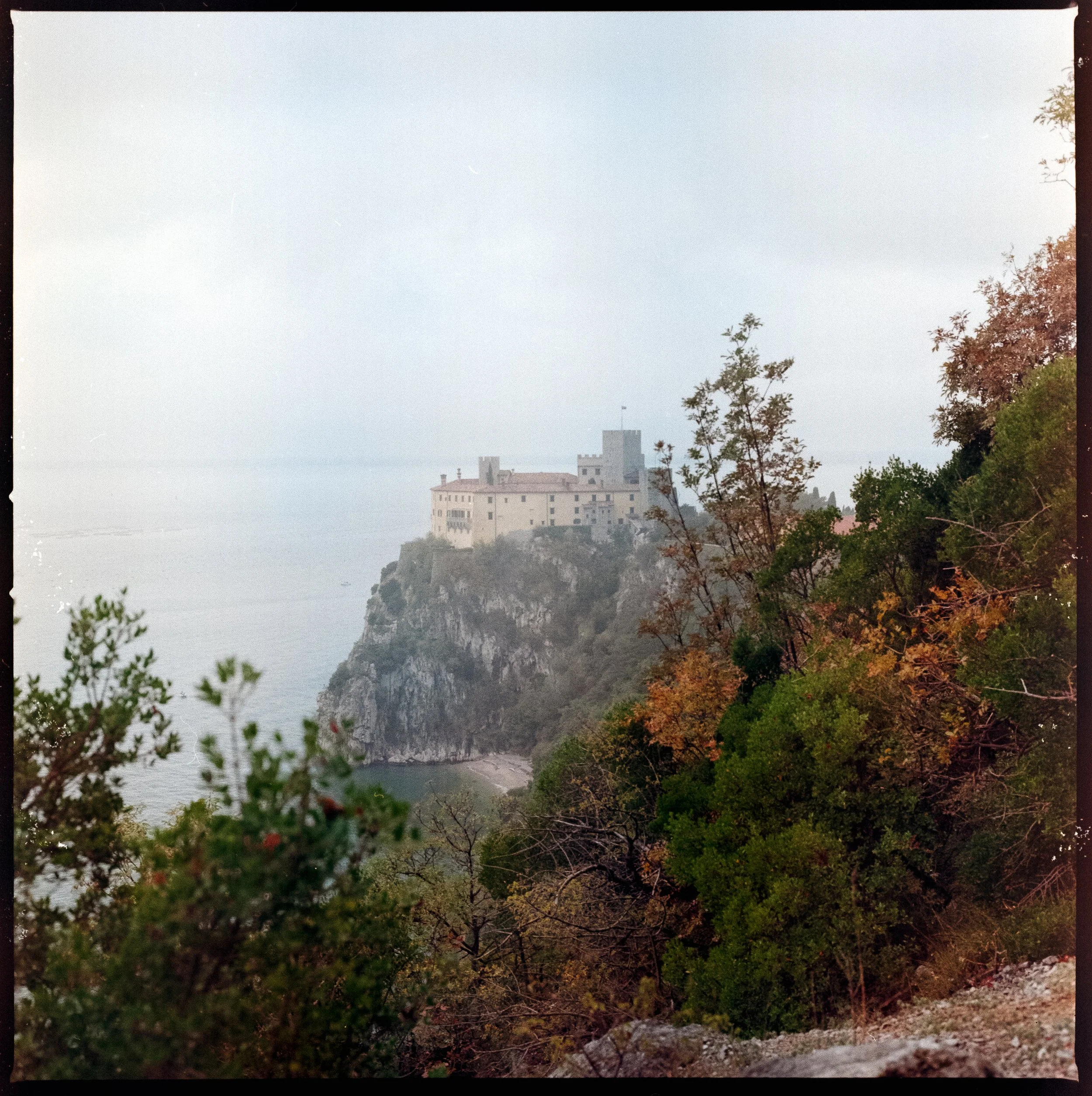
Duino Castle from afar - Hasselblad 500 CM - Kodak Gold 200
Hidden behind the main castle are the ruins of the old one, offering an unparalleled view over Duino Castle. From here, I took what I think was the best shot of the day. The composition came together beautifully — the small bay below with its little hut adds an unexpected focal point, and the mix of blue sea, grey rock, and green trees creates a perfect natural harmony.
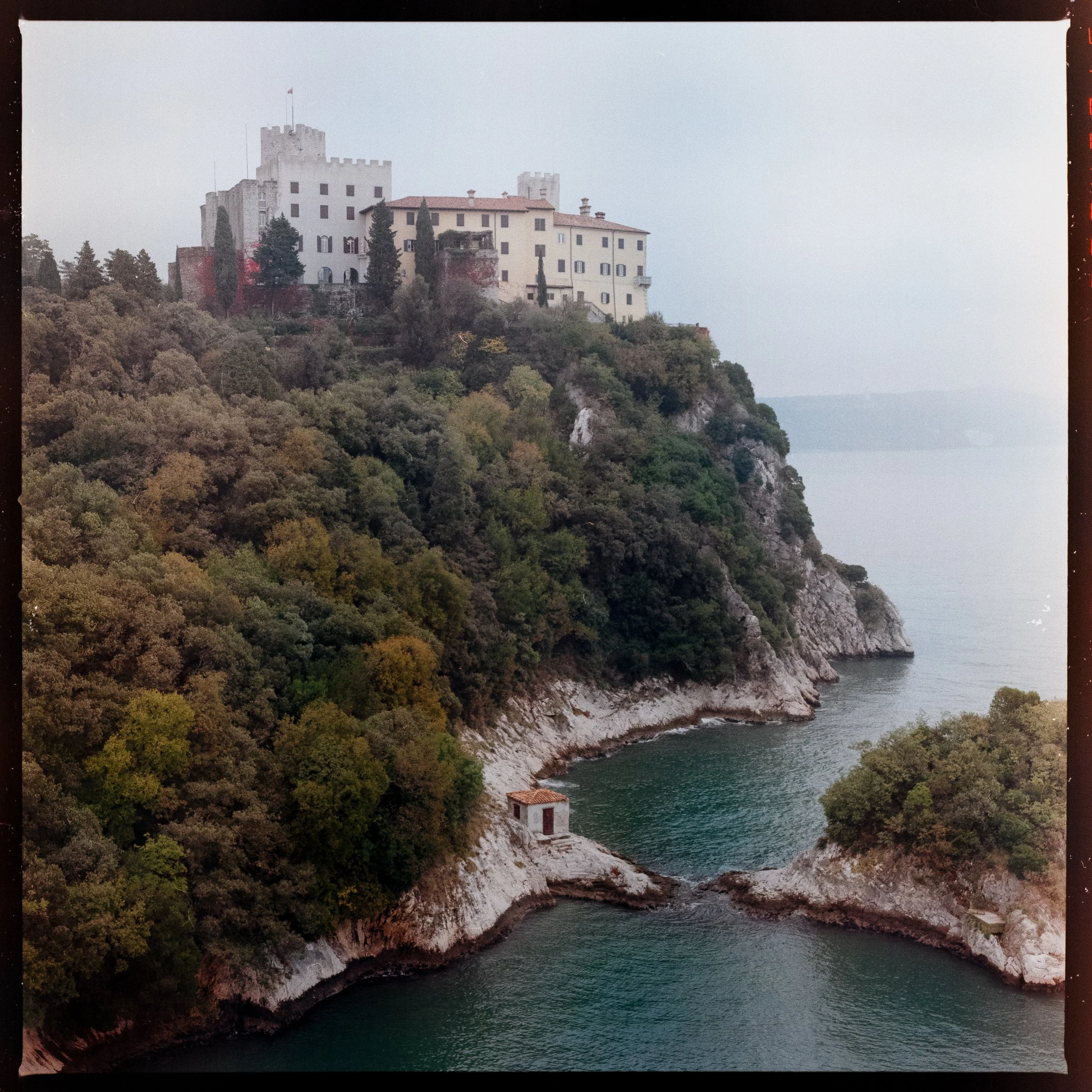
Duino Castle - Hasselblad 500 CM - Kodak Gold 200
As darkness began to fall over the short November day, I took my final shot — the sea and sky merging under soft clouds. I really liked the feeling of this scene and had high expectations for it, but the result didn’t quite match what I imagined, mostly because of the strange orange vertical bars that appeared on the film.
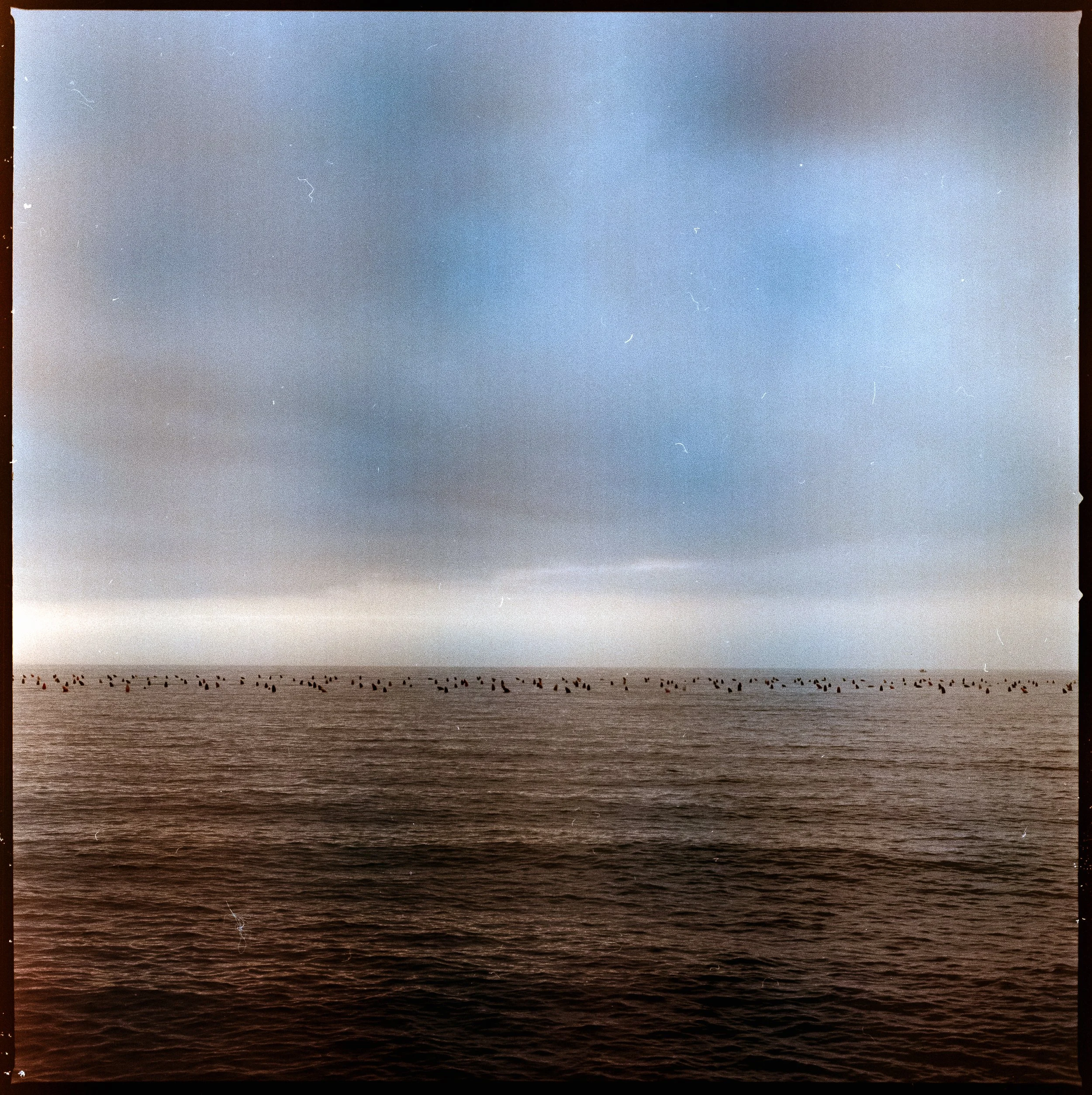
Sea - Hasselblad 500 CM - Kodak Gold 200
The Takeaways
Film photography is hard!
It’s easy to scroll through perfect images on Instagram and think it’s all effortless — but the reality is quite different. The main challenge comes from how constrained the medium is: you have a limited number of shots, you can’t change ISO mid-roll, and especially with medium format, depth of field behaves very differently. You need to stop down much more than expected to get a decent amount of focus — even f/5.6 on a 6×6 frame produces a surprisingly shallow depth of field.
Personally, I don’t mind the long, multi-step process — from shooting to developing and scanning. What I find most difficult is not knowing what went wrong when something doesn’t turn out as expected, and therefore not knowing how to improve.
Take the last picture, for example. It’s hard to tell what caused those distracting orange bars: was it a camera issue? The slightly expired film? A problem during development? Or maybe something in my scanning process? There are so many variables involved that it’s difficult to pinpoint the root cause. That uncertainty can be frustrating — especially when I take the camera out on a day like this, hoping to capture memories I’ll want to look back on.
So, is this the end of film for me? Not quite.
I still love the tactile, deliberate pace of the process, but what I enjoy even more is adapting vintage lenses to modern cameras (you can see some examples with the Zeiss Distagon 35mm f/2.8 and the Zeiss Distagon 28mm f/2.8).
For me, this combination offers the best of both worlds: the character and intentionality of film glass, paired with the control and immediacy of digital.